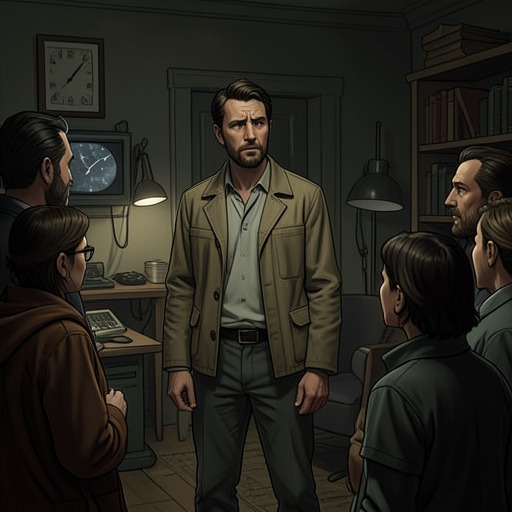
Shevek Cares for an Injured Demonstrator in a Warehouse Cellar
The DispossessedShevek Cares for an Injured Demonstrator in a Warehouse Cellar is the private aftermath of the Nio Esseia demonstration’s public destruction. When the army and police drive the crowd out of Capitol Square, Shevek stays with a wounded Socialist Worker, finds shelter in a locked warehouse, and tries to care for him without access to a doctor. Their three nights in hiding end with the man’s death, bringing the language of solidarity into contact with the practical abandonment produced by the violence around them.
Flight from the Demonstration
Earlier that day, a vast crowd had gathered in Capitol Square for the strike. Shevek had stood with Maedda and others on the Directorate steps, speaking to the demonstrators about shared suffering, mutual aid, and freedom. His appeal described a society without owners or rulers and insisted that revolution could not be bought or made for others: it had to be lived. Police helicopters began firing as he finished. The crowd broke under the noise and attack, and people surged through the Directorate and toward the streets leading away from the Square.
Shevek escaped with a demonstrator who had been near him and Maedda when the firing began. The wounded man had lurched against Shevek for support, and Shevek kept an arm around him through the rush out of the Directorate and the subsequent flight toward Old Town. Their progress became increasingly difficult: the man was weakening, and Shevek had been half-carrying him for several blocks. The demonstration had changed from a mass gathered to hear speakers into a dispersed crowd trapped between police, armored cars, and helicopters.
A Door Opened Against Property
With no safe route forward and the man unable to keep going, Shevek helped him sit on the top step of a basement entrance. The shuttered warehouse windows bore the word STRIKE, but the door was locked. Shevek broke the hasp and padlock with a loose piece of paving stone and went inside. His manner was practical rather than furtive: faced with a locked refuge and an injured companion, he treated access to shelter as a need that outweighed the claim of private ownership.
The cellar was a chemical warehouse, stocked with crates and unoccupied. It had washtubs and a hose, which Shevek used to clean the man’s injured hand and give him water. He improvised a tourniquet and a covering bandage, and helped him drink. The care was limited by the circumstances. At the mills in Southwest, Shevek had seen severe work injuries, but those injured workers had surgeons, plasma, and beds. Here there was no comparable support, only a cellar, basic supplies, and Shevek’s efforts.
Shevek did not know the man’s name. A white armband identified him as a Socialist Worker, and he appeared to be about Shevek’s age, roughly forty or somewhat older. The unnamed companion’s political affiliation is the only identification the scene provides; the danger has reduced a huge public assembly to two individuals in hiding, one trying to keep the other alive.
Care Under Blockade
Shevek went outside to seek help after the armored cars had driven the crowd toward Old Town. When he called to passersby and asked for a doctor, one warned him that the soldiers were coming through and urged him to leave. No one stopped to help carry the wounded man. Seeing blackcoats farther down the street, Shevek returned to the cellar, shut the door, and stayed beside his companion. The attempted appeal for assistance therefore ended not in rescue but in renewed isolation.
The cellar also sharpens Shevek’s understanding of the military organization he had previously discussed with Atro. In a recollection of that conversation, Shevek had questioned a chain of command in which orders descended from generals through officers to privates, calling it inefficient. In hiding, he recognizes that its purpose is not rational cooperation but the efficient killing of unarmed people by soldiers obeying orders. This recognition links the events outside the warehouse to the organization of the violence: the hierarchy that had seemed senseless becomes intelligible as a mechanism of coercion.
As evening fell, Shevek continued to speak to his companion. The man had tried not to impede him during the flight and now lay weak and semi-conscious. When he moaned, Shevek took his good hand and asked him to be quiet, not because the man had done anything wrong, but because Shevek could not bear to hear his pain without being able to relieve it. The companion nodded and shut his lips, apparently understanding the request as a warning not to attract the police. Their small exchange shows how fear alters even a gesture of care: the same words can sound like comfort to one person and concealment to another.
Three Nights and the Cost of Solidarity
The men remained in the cellar for three nights. Sporadic fighting continued in the warehouse district, and an army blockade held the stretch of Mesee Boulevard outside. The fighting did not come very close, but the heavily guarded block left them no way out without surrendering themselves. When Shevek asked what the police would do if they went out, the man whispered that they would shoot them. His smile was difficult for Shevek to interpret; the scene offers no explanation for it.
The wounded demonstrator died of blood loss during the night while the two men lay side by side for warmth on a mattress Shevek had made from packing-crate straw. Shevek awoke to find him dead and listened to the silence in the cellar, on the street, and across the city. The mass demonstration and its collective voice had given way to the stillness of the hidden dead. The outcome marks the limit of Shevek’s improvised care: he can break a lock, shelter another person, and remain beside him, but he cannot replace the medical help or safety denied by the surrounding crisis.
The episode gives physical circumstances to the solidarity Shevek had described in the Square. There, he had said that people know their brotherhood through suffering and have no help except from one another. In the cellar, this principle is no longer a speech addressed to thousands; it is the sustained act of staying with an injured stranger when public institutions and passing demonstrators offer no aid. Yet the episode also refuses to present mutual aid as a guarantee of survival. Shevek’s care matters precisely because it cannot undo the political violence, the blockade, or the absence of treatment that ends in the man’s death.